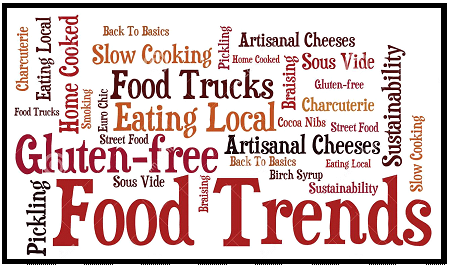

At the tail end of each year the food media ask leading “industry professionals” to try and predict the food trends for the following year and then rank them accordingly. For the past 10 – 15 years the “hot” items have generally included variations on whole beast dining, fire and smoke, wild food, native ingredients, comfort food, fermentation, kitchen gardens, savoury desserts, barissta coffee and food trucks, plus of course, the loopy dietary trends that eventually become entrenched in popular culture for no good reason other than hype, I’m thinking Paleo, raw food and dairy free anything.
A few years back now , the ABC news previewed their predictions for 2016 and apparently Kale would be “out of favour” and the big trend to watch out for was going to be $20 a litre Camel milk, with Seaweed becoming a staple. To be honest anyone with their nose in the food trough probably sneered at this as old news with these having hyped up a couple of years earlier. However, looking back on these predications how close did they get ?
Well, 4 years on, and while every possible milk variant has filled supermarket shelves, I seriously doubt the likelihood of Camel milk becoming mainstream. I simply dont see the public lining up to scoff Camel milk Pannacotta or chug Camel Milk Lattes any time soon. To be honest, its hard enough to secure acceptance for the milk of familiar and highly domesticated animals like sheep, and goat milk really only become readily available in some supermarkets over the last 10 years, and don’t get me started on the fracas that is “bath milk” (read raw unpasteurized cow milk).

However seaweed, was another altogether matter, easily making the leap with just about every chef worth his salt embracing kombu or wakame as a serious ingredient rather than a novelty garnish. But then really, should that surprise us, seaweed has long been on our tables thanks to rice crackers and sushi as well as in extracts or alginates that are commonly used in food manufacturing for everything from confectionary to dairy foods and beyond. But has this used trickled down to the home kitchen?.
I suspect that while the “superfoods” and wellness phenomenon is still running rampant there may be the odd pack of seaweed thingo lurking in the back of some pantries. However, by and large it hasn’t permeated the average household meal plan. Is this because its considered too exotic, something more in common with fringe East Asian cuisine than is comfortable for the greater WASP-ish community? …If that is the thinking then we couldn’t be further from the truth because the consumption of sea vegetables has very deep roots in the west.
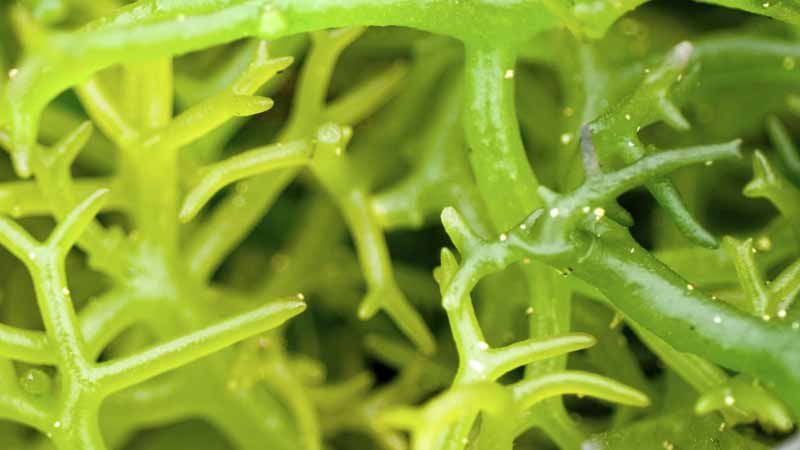
Without a doubt, my Celtic forebears in Ireland and Wales would have foraged for algae and seaweed as a matter of survival (not hisptergram fame) to make laverbread and carrageen jelly among other dishes. Over time these remote and rural traditions did make their way into the household kitchen with an air of respectability that still survive in pockets today and are undergoing a quiet resurgence particularly in Ireland and as always “everything once old is new again”.
With this in mind i have reproduced below a recipe by Theodora Fitzgibbon, from her “A Taste Of Ireland” cookbook, a book was gifted me when i first started cooking back by my dear Nanny Mac a native of Sligo on Ireland’s wild west Atlantic coast.
OCEAN SWELL JELLY
Chondus crispus is a seaweed called Irish Moss or Sea Moss (which makes ‘Carragreen’). It is dark purple or green in colour but when dried it has a bleached look. Because of its gelatinous quality it is used as a vegetable gelatine and makes excellent jellies, aspics, beverages and even breads and pastries. The rich vitamin content makes it an ideal food substance and prepared ‘carrageen’ can be bought from most health food shops.
100g dried carrageen – tightly packed
2 tablespoons caster sugar
600ml water
1 egg white
150ml cream – whipped
1 lemon – zest only
Method
Cover the carrageen in water and steep for 10 minutes to rehydrate then drain.
Simmer for 25-30 minutes in the water with the sugar and lemon zest. Strain and let the liquid cool slightly.
While it is cooling, whip the egg white stiffly and combine with the cream.
Mix with the carrageen liquid and gently heat up to just under boiling point. Pour into a wet mould and chill.
Turn out of the mould and serve with fresh fruit.
 Food Luddite